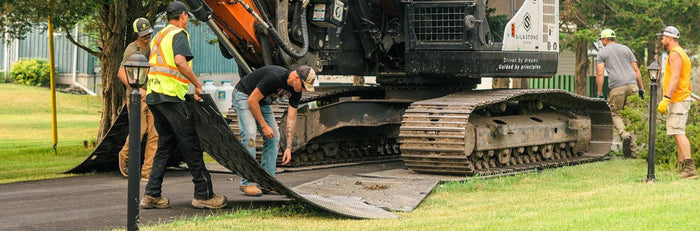
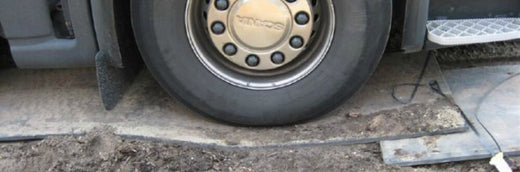
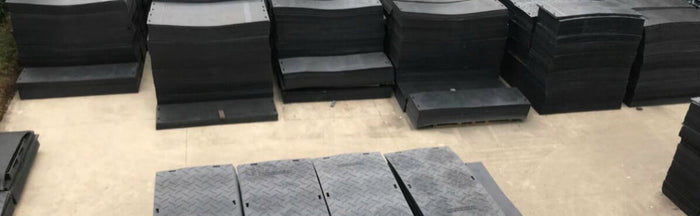
A muddy job site or a soaked event lawn can stall a project fast. Equipment gets stuck, crews lose footing, and the ground itself takes damage that costs money to repair. Ground protection mats solve that problem, but choosing between single-sided and double-sided ground mats isn't always obvious. Both styles protect the surface underneath and give equipment and people a solid place to stand, but they differ in how they're built and where they perform best. This guide breaks down the design, functionality, durability, and value of each so you can match the right mat to your project.
What Are Single-Sided Ground Mats?
Single-sided mats have one textured, slip-resistant working surface on top and a smooth or grip-oriented underside built to sit against the ground rather than flip into use. That single working face keeps the mat's construction simpler and its price lower, which is why single-sided mats are a common choice for jobs where the mat goes down once and stays put for the duration of the work.
PrimaMat's 3'x8' single-sided mat and 4'x8' single-sided mat both use 100% recycled polyethylene, run 0.75 inches thick*, and carry a 50 to 70 ton load capacity. Six integrated handles make one-person placement possible, and the surface resists weathering, abrasion, and impact across grass, dirt, mud, sand, gravel, asphalt, and concrete.
What Are Double-Sided Ground Mats?
Double-sided mats are built with two usable working surfaces, so when one side wears down or picks up debris, the crew can flip the mat and keep working instead of swapping it out. That reversibility adds versatility to longer projects or sites where the mat gets moved and repositioned often across different terrain.
PrimaMat's 3'x8' and 4'x8' double-sided mats share the same recycled polyethylene construction, 0.75-inch thickness*, and 50- to 70-ton load rating as the single-sided line, with a slip-resistant top and a strong-grip bottom on both faces. Both sizes accept the steel connector system for locking multiple mats together into a continuous path.

Key Differences in Design, Functionality, and Usability
The construction difference is straightforward: one working face versus two. That single distinction drives most of the practical differences between the two styles.
-
Surface use: Single-sided mats commit to one working face for the life of the mat. Double-sided mats give crews a second face to fall back on.
-
Handling in the field: Both styles use the same six-handle layout and connector compatibility, so setup and connection speed are identical.
-
Weight and footprint: Dimensions, thickness, and weight are matched across the single and double-sided versions in each size, so switching styles doesn't change how many mats fit on a trailer or how many people it takes to carry one.
-
Terrain conformity: Both styles flex to uneven and sloped ground the same way, since the underlying material and thickness don't change.
Benefits of Single-Sided Mats
The benefits of single-sided mats come down to cost and simplicity. With one working surface to engineer, the mats typically run less expensive than a double-sided equivalent of the same size, which matters on projects that need a large quantity of mats or a tight materials budget. They're a strong fit for shorter-duration jobs, event flooring, and situations where the mat stays in one spot facing one direction, such as lining a walkway or protecting a single access route.
Benefits of Double-Sided Mats
The benefits of double-sided mats center on extended usable life and flexibility. Because either face can go down, crews get roughly double the wear surface out of the same mat before it needs replacing. That makes double-sided mats a better match for long-haul construction projects, repeated rentals, or any job where mats get picked up, moved, and repositioned across a changing site. The ability to flip a worn or debris-covered side also keeps the working surface consistently slip-resistant without pulling the mat out of rotation.
Durability and Value Comparison
Both mat types are built from the same 100% recycled polyethylene and carry identical resistance to UV exposure, frost, chemicals, and impact. Neither style is inherently more durable in terms of the material itself. The difference shows up in usable lifespan: a double-sided mat effectively doubles the wear surface, which can lower the cost per use over time even though the upfront price is higher.
For short jobs, single-sided mats deliver better value since the second face would rarely see use anyway. For projects running months or years, or for rental fleets moving between sites, double-sided mats spread the initial cost across more working life and usually come out ahead on total value.
Choosing the Right Mat for Your Project
-
Construction sites: Long-duration builds with heavy equipment traffic and repositioning benefit from double-sided mats and their extended wear life.
-
Landscaping projects: Shorter jobs protecting a single path or work area are well served by single-sided mats at a lower entry cost.
-
Event setups: Temporary walkways and staging areas that go down once and come up once rarely need a second face, making single-sided mats the practical choice.
-
Rental and multi-site use: Mats that travel between jobs and see repeated setup and teardown get more value from a double-sided design.
Whatever the application, browse the full ground protection mat collection to compare sizes and styles side by side before ordering.
Best Single-Sided Ground Mats
For crews weighing the best single-sided ground mats for a project, size is the main decision point once the single-sided style is chosen. The 3'x8' single-sided mat suits narrower walkways and lighter equipment paths, while the 4'x8' single-sided mat covers more ground per mat and handles wider equipment routes with fewer seams between panels.
Best Double-Sided Ground Mats
Among the best double-sided ground mats, the same sizing logic applies. The 3'x8' double-sided mat works well for tighter access points and cemetery or facility grounds, and the 4'x8' double-sided mat is built for larger construction and infrastructure projects that need broader, more stable coverage.
Frequently Asked Questions
Are double-sided mats more durable than single-sided mats?
Both styles use the same recycled polyethylene material and carry identical resistance to weathering, chemicals, and impact, so durability per surface is equal. Double-sided mats last longer in practical use because the second face extends the mat's total working life once the first side wears down.
Can single-sided mats be used in wet or slippery conditions?
Yes. Single-sided mats use the same anti-slip top surface as their double-sided counterparts, so they perform the same way in wet, muddy, or icy conditions. The single working face doesn't reduce slip resistance.
Do double-sided mats require any special accessories?
No special accessories are required. Double-sided mats use the same steel connector system as single-sided mats for linking multiple panels together, and both styles use the same handle design for transport and placement.
*Thickness: Thickness is measured at the tread.